
Start with the actual difference: whether the toes are enclosed. Then check the shoes and any fitting aid you plan to use, rather than assuming an open toe solves every foot-fit problem.
Guy’s and St Thomas’ NHS distinguishes the two designs by their toe sections. MedlinePlus advises discussing the right kind of compression stockings with your provider.
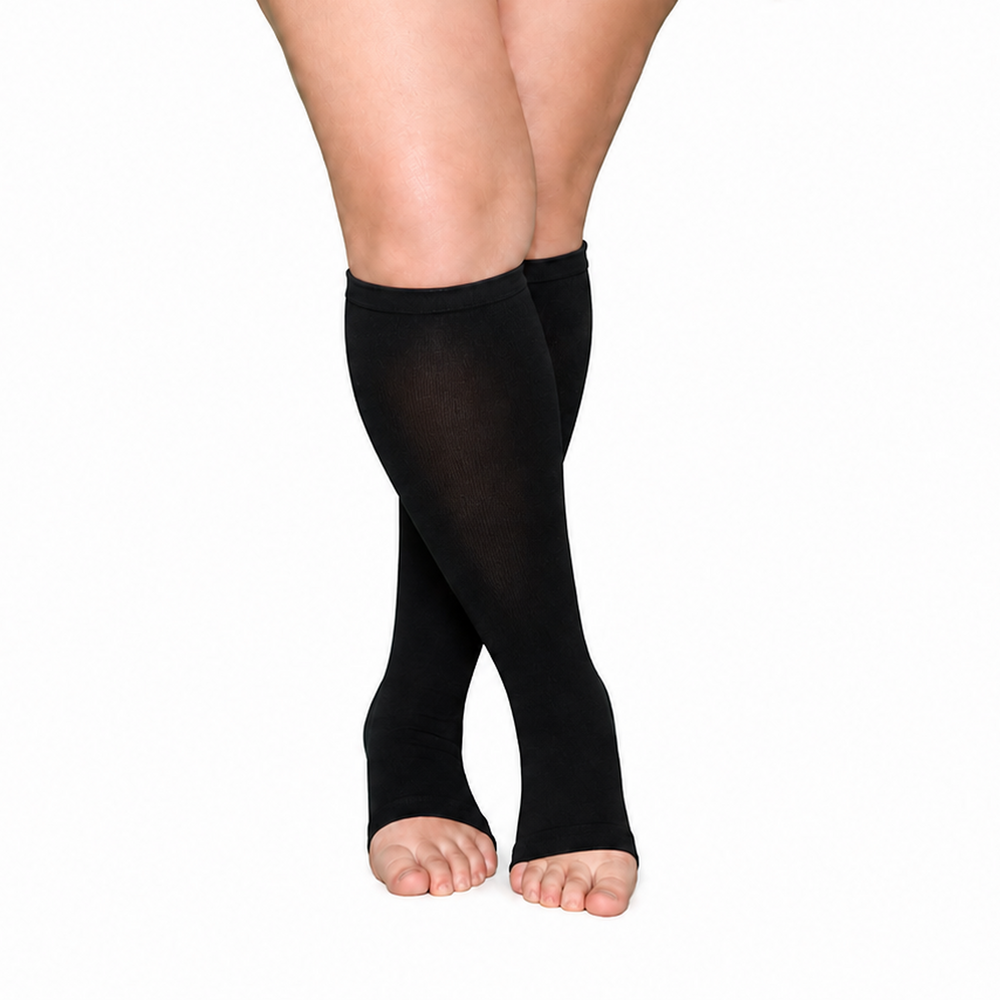
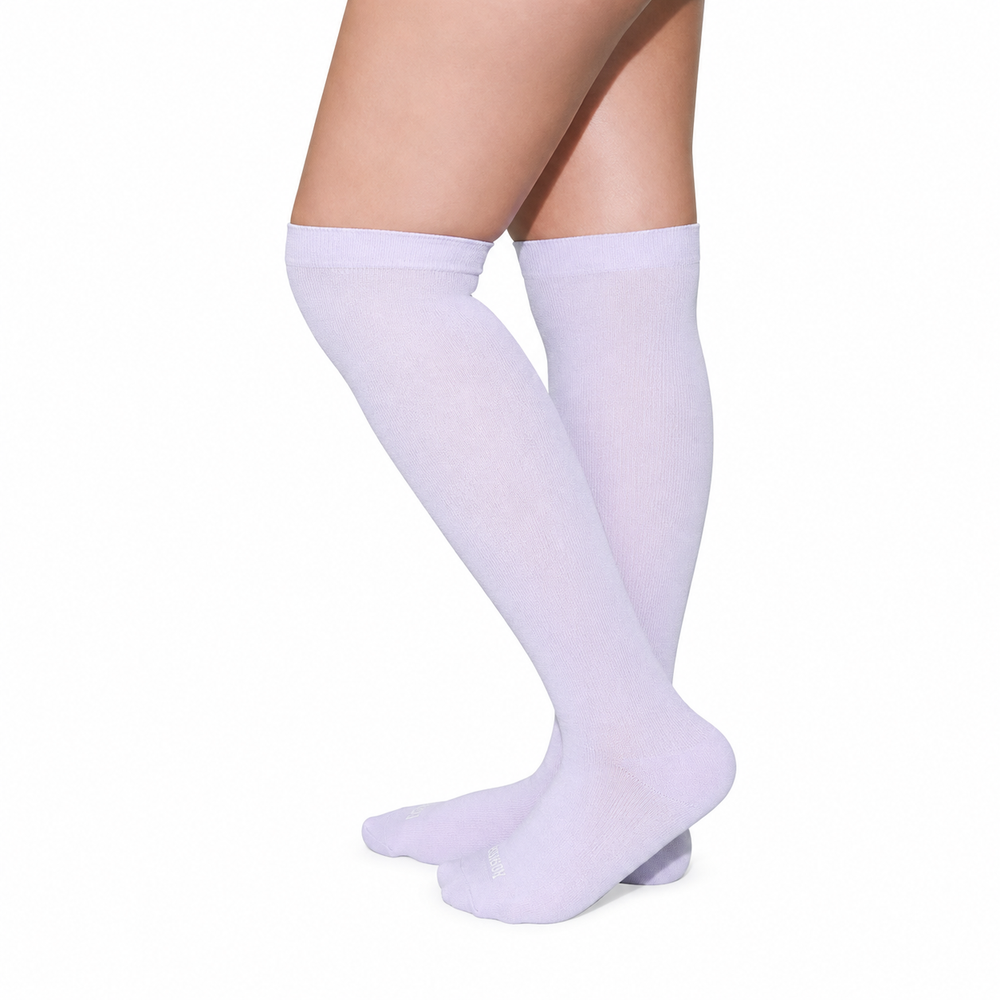
What is the difference between open-toe and closed-toe compression socks?
Toe coverage is the design difference. The following practical examples come from the separate Guy's and St Thomas' NHS instructions, not a test ranking all products:
| Detail | Open-toe | Closed-toe |
|---|---|---|
| Toe coverage | No enclosing toe section. | A fabric toe section encloses the toes. |
| Aid in this hospital's example | A supplied easy-on slipper is removed through the toe opening. | The closed-toe instructions do not establish that this same slipper method is compatible. |
| Finished position in those instructions | Heel and toes should sit properly. | Heel and toe sections should be correctly placed. |
What this does not tell you: how warm, roomy, or easy to use your pair will feel, whether it works with your shoes, or whether it can replace a prescribed garment. Check those questions for the exact product; do not turn a coverage difference into a medical recommendation.

Toe coverage is only one part of the design
Think of toe coverage, leg length, and circumference as separate questions. The German Phlebology Society's S2k guideline, published in 2021, discusses these features separately and says that a medical stocking's length and circumference must fit the person's anatomy. That clinical principle does not make an open-toe pair equivalent to a closed-toe pair carrying the same size letter.
This explains a common dead end in shopping: confirming that the toes will be uncovered still leaves the calf and length questions unanswered. Likewise, choosing a closed toe tells you where fabric is present, not how much room your foot will have. Look for the exact product's sizing and fitting instructions instead of transferring answers from a similar-looking pair.
Make the comparison about your actual morning
Imagine comparing two documented options because you prefer uncovered toes with a particular shoe. Before deciding, separate what is already settled from what could change the choice. You may know the appearance you prefer but still need to confirm the opening's instructed position or whether your current aid works with that model. A clear preference and an unanswered practical question can exist together.
Now consider the reverse: you like a covered-toe appearance and already have instructions for a particular closed-toe garment. An advertisement calling open-toe “easy on” does not, by itself, supply a better routine. Ask what aid is involved and whether the claim refers to that aid, the garment, or a tested comparison. The hospital's slipper example above is useful precisely because it describes a particular combination.
These are hypothetical shopping situations, not patient cases. Their purpose is to help you reach an answer that names a product, a shoe and an aid, rather than ending with “open-toe is better.” When a clinician selected the current garment, discuss any substitution with that clinician; the comparison cannot settle the clinical decision.
Start with the shoes you actually want to wear
Use the shoe you intend to wear, not a generic label such as “sandals.” Separate the appearance you prefer from a pairing that still needs checking.
To ask a useful product question, send the stocking model, shoe model or photo, and exact uncertainty: covered toes showing through an open shoe, the position of the stocking opening, or a question about the manufacturer's instructions. For symptoms rather than appearance, use the next section's healthcare advice.
A seller or dispensing fitter can explain the product details. They cannot establish personal medical suitability just from a clothing preference or a product photograph.
Does a crowded toe section mean you need an open-toe pair?
Not from that description alone. A complaint about toe space is a question to investigate, not a diagnosis or an instruction to switch styles.
Do not treat symptoms as a clothing problem. Cleveland Clinic advises removing compression socks that feel uncomfortably tight. If you notice pain, numbness, tingling, skin discoloration or damage, or worsening swelling, remove them and call your healthcare provider.
For closed-toe stockings, Guy’s and St Thomas’ NHS says to check that the heel and toe sections sit correctly. That positioning check does not, by itself, establish medical suitability.
For a non-symptom question, describe whether the issue is the toe covering, shoe choice, or the instructed position. Keep the exact product details with the question instead of asking for a category-wide winner.
Check the fitting aid, not just the toe opening
An open toe does not establish that every fitting aid will work with the stocking.
The Guy’s and St Thomas’ NHS instructions describe a supplied easy-on slipper for the open-toe stocking. In that specific method, the slipper is removed through the toe opening.
That example is not a promise that every open-toe pair includes a slipper or uses the same method.
Before relying on an aid, ask:
- Is this aid intended for the exact stocking I am considering?
- Is it included, or would I need to obtain it separately?
- Where are the instructions for using this combination?
If you cannot confirm compatibility, leave that field unanswered. Do not turn a video of another product into instructions for yours.
Fill in your toe-coverage decision card
Complete one short record for each pair you are considering:
| Detail | Your note |
|---|---|
| Stocking and coverage | Exact name/link; open or closed toe; which coverage you prefer. |
| Leg length | Copy the listed length separately from the toe style. |
| Shoes | Exact pair and any appearance or compatibility question. |
| Aid | Exact aid name, whether included, and where this combination's instructions are available. |
| Care and unresolved question | Existing provider instructions; the one question still preventing a decision. |
The NHS lists leg length and foot style separately. Open-toe does not mean a shorter leg section. Leave missing information marked “unknown”; a completed record is not medical clearance.
Take one clear question to your provider or fitter
Match the question to the person who can answer it. Ask the seller or dispensing fitter for product details and aid instructions. Ask the clinician responsible for your care before substituting a provider-selected garment; MedlinePlus directs the choice of appropriate stocking type to that discussion.
Product-detail request:
For the clinical conversation, add: “I currently use [prescribed garment]. Would a different toe style be appropriate for me?” Do not treat a seller's compatibility answer as approval to make that change.
The bottom line
Compare toe coverage, exact shoe details, and the aid's instructions as separate questions. Keep prescribed-garment decisions with the responsible clinician, and do not use a style comparison to manage new symptoms.
Frequently asked questions
Are open-toe compression socks easier to put on?
This comparison does not establish that. The hospital guide describes one supplied slipper used with an open-toe stocking; confirm the instructions and compatibility for your own stocking and aid.
Can I choose open-toe compression socks just to wear sandals?
You can record sandals as a clothing preference. Do not treat that preference as confirmation of fit or as a reason to replace a provider-selected stocking without discussion.
Does open-toe mean a shorter stocking?
No: open-toe describes the toe section, not the leg length. The NHS lists foot style and length as separate options; check the exact product details.
Can I replace a prescribed closed-toe pair with an open-toe pair?
Ask your provider before making that substitution. MedlinePlus advises discussing the appropriate kind of stocking; this article does not establish that two specific pairs are interchangeable.
Sources
- Rabe et al. (2021): German Phlebology Society S2k compression guideline. DOI: 10.1007/s00105-020-04706-z. Cited for separate fit dimensions, not a pressure prescription.
- Guy’s and St Thomas’ NHS: Compression stockings
- NHS: Varicose eczema—treatment — cited only for stocking length and foot-style options.
- MedlinePlus: How to use compression stockings